Nitrogen is an essential element of life, and its availability often limits crop yields. The Haber-Bosh process allows nitrogen fixation, the conversion of dinitrogen from the air into ammonia, using natural gas as the energy source, and the production of synthetic fertilizers at an industrial scale. The use of these synthetic fertilizers increased drastically during the Green Revolution and currently allow sustaining about half of the world population. Such a dependence of our agriculture on fertilizers produced from natural gas, a finite resource, as well as the adverse effects of fertilizers on our environment are significant threats to the sustainability of our agriculture. Access to synthetic fertilizers is also challenging for poor farmers in developing countries. Taking more advantage of biological nitrogen fixation performed by prokaryotes expressing the nitrogenase enzyme, also called diazotrophs, seems a logical approach to reducing our dependence on synthetic fertilizers. In particular, cereals require large amounts of nitrogen inputs to reach good yields and, unlike legumes, associate generally poorly with diazotrophs.
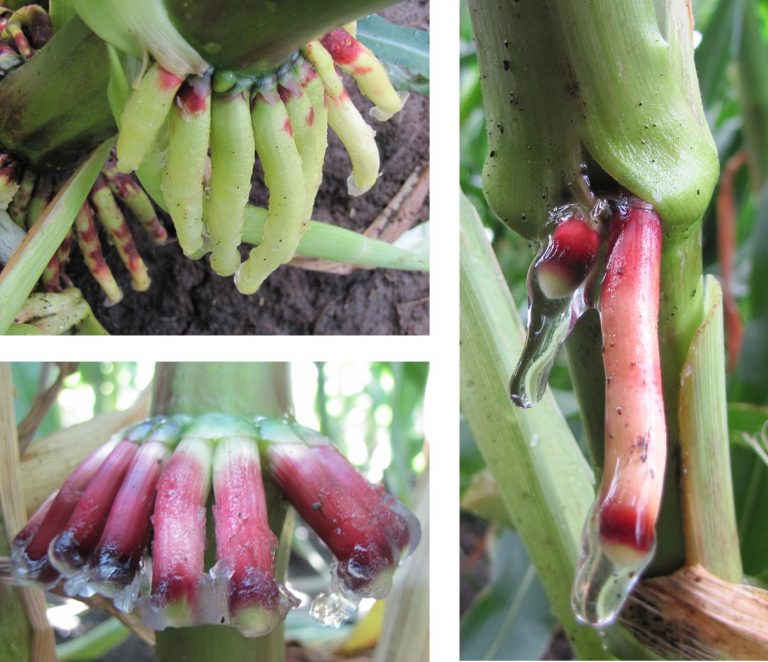
Improving associations between corn, in particular, and diazotrophs has been a dream of the research community for decades. We found recently that landraces of corn from the Sierra Mixe in Oaxaca, Mexico can acquire more than half of their nitrogen from the air during four months of the growing season by hosting a wide range of diazotrophs in a thick mucilage produced by aerial roots after rain. These landraces produce 8-10 nodes with aerial roots whereas most conventional varieties carry only one to three. These aerial roots are also thicker than those of conventional corn, and we showed a correlation between root thickness and the volume of mucilage produced. Preliminary data also indicate that the nitrogen fixation trait can be introgressed into conventional varieties of through crosses.
GOALS
We aim to gain a better understanding of the environmental factors, the genes and the molecular mechanisms controlling aerial root development, mucilage production and nitrogen fixation in the mucilage produced by aerial roots of these corn landraces. The specific objectives of this project are to:
- Determine the environmental factors affecting aerial root development and mucilage production
- Identify the genetic determinants of aerial root development, mucilage production, and
associative nitrogen fixation. We use double haploids and rAmpSeq to map the loci controlling these traits. - Analyze the molecular and biochemical basis of mucilage production and degradation on aerial roots in response to water. This objective is achieved using RNA-Seq and enzymatic assays.
- Understand and improve the transfer of fixed nitrogen between diazotrophs and corn in aerial roots. We address this objective using a combination of 16S and ITS amplicon sequencing, isolation of microbes, and inoculation experiments.
The maize accessions that we are working on are publicly available and come from the CIMMYT and the USDA-GRIN.